


Commercial coffee machine installation: what you need before install day
Quick answer: to install a commercial coffee machine you need a cold mains water supply with an isolating valve and a 3/4 inch BSP connection within 1 to 1.5 m of the machine, a drain within 1 to 1.5 m, and the right electrical supply. Bean to cup machines usually run from a 13A socket. Traditional espresso machines usually need a dedicated 20A supply fitted by a qualified electrician, and larger machines can need 32A. You also need a strong, level counter with room around the machine, a clear route in and somewhere to park. Get these ready before install day and your engineer can connect and commission your machine, and fit the water filter, in one visit.
Summary: what you need to install a commercial coffee machine
- Water: cold mains supply within 1 to 1.5 m, with an isolating valve and a 3/4 inch BSP connection
- Drain: a waste point within 1 to 1.5 m of the machine
- Power: 13A socket for most bean to cup machines, a dedicated 20A supply for most traditional espresso machines, or up to 32A for larger machines, plus a 13A socket for the grinder
- Space: a level, strong counter with room for the machine, grinder, water filter and airflow
- Access and parking: a clear route from the van to the machine position, and somewhere to park or load
- Water filter: we fit the water filter on install day, so leave room for it under or near the machine
- Site survey: we send you a short survey to fill in on your phone, with photos, before we book the installation
- Call-out rule: if the site is not ready on the day, a £180 call-out charge applies, unless we have agreed in writing to do the work
This guide was written with the Cool Beans Coffee installation team in Blackpool. We supply, install and look after commercial coffee machines for cafes, hotels, offices, convenience stores, care homes and forecourts across the UK, and we are an official La Marzocco UK distributor. The photos below show real, ready sites, so you can see exactly what a ready site looks like.
Commercial coffee machine installation checklist
Print this list and tick each item off with your plumber, electrician and staff. If you can tick every box, your site is ready.
| ✓ | Item | Who usually does it |
|---|---|---|
| □ | Machine position agreed, with the machine, grinder and water filter measured against the counter | You |
| □ | Counter is level, strong and finished, with any holes for hoses and cables already cut | You, joiner or shopfitter |
| □ | Cold mains water supply within 1 to 1.5 m of the machine | Plumber |
| □ | Isolating valve fitted, with a 3/4 inch BSP connection | Plumber |
| □ | Drain or waste point within 1 to 1.5 m of the machine | Plumber |
| □ | Correct electrical supply for your machine fitted and working: 13A, 20A or 32A | Qualified electrician |
| □ | Separate 13A socket for the grinder on traditional espresso set-ups | Qualified electrician |
| □ | Space around the machine for air to move and for cleaning and servicing | You |
| □ | Clear route from the van to the machine position, including steps and corridors | You |
| □ | Parking or loading space near the entrance for install day | You |
| □ | Site survey completed on your phone, with photos | You |
| □ | Staff who will use the machine are on site for the handover | You |
Water supply: what your plumber needs to fit
Most commercial coffee machines are plumbed into the mains, so they fill themselves and never run dry in the middle of a rush. Your water supply needs:
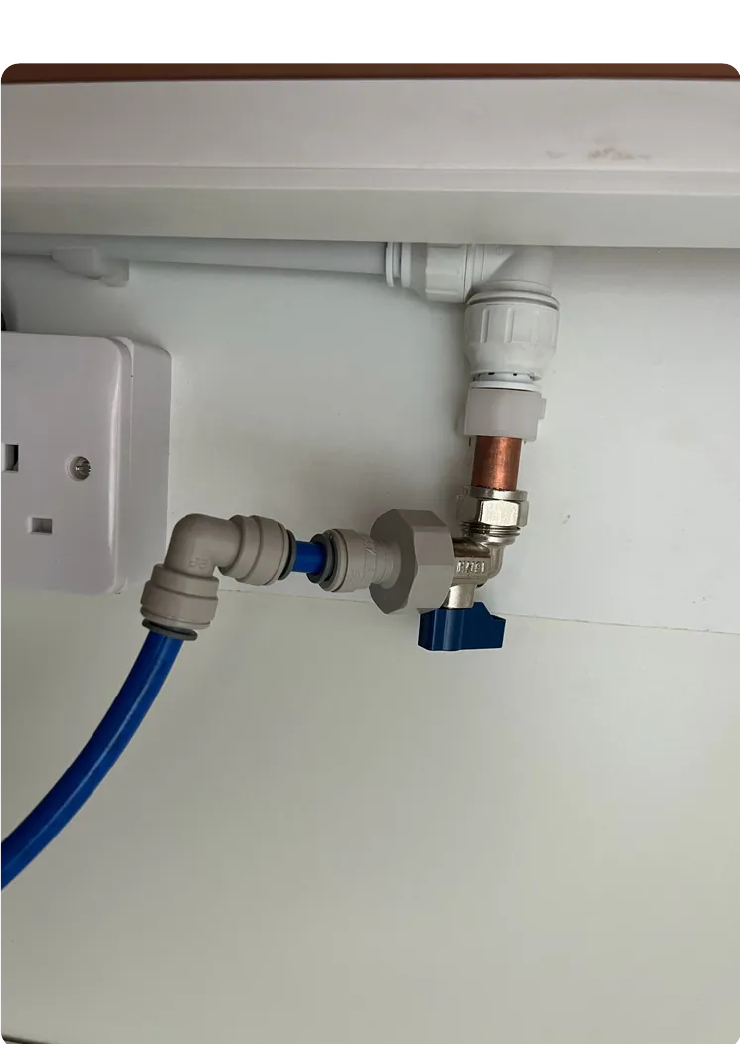
- A cold mains water supply within 1 to 1.5 m of where the machine will sit.
- An isolating valve on that supply, so the water to the machine can be turned off on its own without shutting off the whole building.
- A 3/4 inch BSP connection on the valve, which is the fitting the machine’s hose connects to.
Tips that save time on install day
- Use a dedicated supply for the machine. Ask your plumber to run a supply to the machine position rather than relying on a shared feed under a sink or dishwasher.
- Keep the valve easy to reach. Staff and engineers need to turn it off quickly for servicing or a leak.
- Think about your water. In hard water areas, limescale is one of the most common causes of breakdowns. A water filter or softener protects the boiler and helps the coffee taste as it should. We fit the water filter on install day and can advise on the right one for your area.
Drainage: where the waste water goes
Plumbed-in commercial machines send waste water from the drip tray to a drain. You need:
- A drain or waste point within 1 to 1.5 m of the machine.
- A hose route that falls downwards all the way to the drain. Coffee grounds and milk can settle in hoses that run flat or loop upwards, leading to blockages and overflowing drip trays.
Some smaller bean to cup machines can run without a drain and use a drip tray that staff empty by hand. For a busy site, a drain connection is far easier to live with.
Electrical requirements for commercial coffee machines
Electrics are the most common reason an installation cannot go ahead, so it is worth getting this right first time. The supply you need depends on the machine’s power, shown in watts (W) or kilowatts (kW) on its rating plate and in the specification we send you.
- Bean to cup machines usually run from a standard 13A socket.
- Traditional espresso machines usually need a dedicated 20A supply, installed by a qualified electrician.
- Larger machines, such as bigger multi-group espresso machines, can need up to 32A, single or three phase.
- Grinders use a standard 13A three-pin socket, so plan one next to the espresso machine.
| Machine power | Current | What to fit | Typical machines |
|---|---|---|---|
| Grinder | Standard socket | Standard 230V 13A three-pin socket | Coffee grinders |
| Up to 3kW (3,000W) | 13A | Fitted with a three-pin plug into a 13A socket | Most bean to cup machines |
| Up to 3.8kW (3,800W) | 16A | 20A single plate isolator or a 16A commando socket | Most traditional espresso machines |
| Up to 7.6kW (7,600W) | 32A, single or three phase | The relevant phase commando socket, a 32A rotary isolator, a 32A single switch or a 45A double switch | Larger espresso machines |
Always check the rating plate or specification for your exact machine. We confirm the supply needed when we send your site survey.


Electrical tips
- Use a qualified electrician for any new circuit, isolator or commando socket, working to the current UK wiring regulations (BS 7671).
- Label the isolator “Coffee machine” so staff can find it quickly.
- Do not share the circuit with a dishwasher, fridge or other heavy equipment, and never use an extension lead or adaptor for the machine.
- Have it live and tested before install day. Our engineers connect your machine to the supply you have prepared.
Space, counter and ventilation
Commercial machines are heavy and give off heat and steam, so plan the space properly.

- A strong, level counter. The worktop must take the weight of the machine full of water, and must not flex or move.
- Room for everything. Allow space for the machine, the grinder next to it, a knock-out drawer, cups and the water filter underneath.
- Height clearance. Leave space above the machine to fill the bean hopper on a bean to cup machine, warm cups and work comfortably. Watch out for low shelves and cupboards.
- Airflow. Do not box the machine in. Leave space around it so heat and steam can escape, and keep vents clear.
- Holes for services. If the water, drain and power are under the counter, have a hole cut through the worktop for the hoses and cables before install day.
- Workflow. Place the grinder next to the espresso machine, with the milk fridge close by, so staff are not walking back and forth.
Access and parking on install day
Our engineers need to get the machine from the van to its final position safely.
- A clear route from the entrance to the machine position. Tell us about steps, stairs, lifts, tight corners or anything that could slow things down.
- Somewhere to park or load close to the entrance, and any parking restrictions, permits or height barriers we should know about.
- Someone on site who can let us in, confirm the position and take the handover.
The Cool Beans site survey: how it works
Before we book your installation, we send you a short site survey. You fill it in on your phone in a few minutes and take photos as you go. It covers:
- Water: is there a cold mains supply with an isolating valve near the machine position?
- Drainage: is there a drain or waste point close by?
- Electrics: which socket or isolator is fitted, matched to your machine?
- Space: worktop size, clearance and where the grinder goes.
- Access: the route from the van to the machine.
- Parking: where we can park or load.
- Contact: who we should speak to on the day.
- Notes: anything else we should know.
Each step shows an example picture of what “ready” looks like. When you finish, your answers and photos come straight to your engineer, so anything missing is spotted before install day.
What happens on installation day
- We deliver the machine and position it on the counter.
- We connect it to your water, drain and electrical supply.
- We fit the water filter.
- We commission the machine, check for leaks and set it up with your coffee.
- We hand the machine over ready to use. Ask us about our barista training courses.
The £180 call-out rule: why site readiness matters
Our engineers connect your machine to the water, drain and power you have prepared. If the site is not ready on install day, for example there is no isolating valve, no drain nearby or the wrong electrical supply, the engineer cannot finish the job. In that case a £180 call-out charge applies, unless we have agreed in writing that Cool Beans will do that work.
The easiest way to avoid it is to complete the site survey with clear photos and tick off the checklist above before the day. If you are unsure about anything, call us and we will talk it through.
Bean to cup vs traditional espresso: installation differences
| Bean to cup machine | Traditional espresso machine | |
|---|---|---|
| Electrics | Usually a 13A socket | Usually a dedicated 20A supply by a qualified electrician; larger machines up to 32A |
| Grinder | Built in | Separate grinder on its own 13A socket |
| Water | Cold mains supply with isolating valve; some smaller models can use a tank | Cold mains supply with isolating valve and 3/4 inch BSP connection |
| Drain | Recommended for busy sites; some can use a drip tray | Drain within 1 to 1.5 m |
| Space | Room above for filling the bean hopper | Room for the machine, grinder, knock-out drawer and milk |
| What staff learn | Mostly cleaning and refilling | Grinding, extraction, milk steaming and cleaning |
Not sure which type suits your business? Read our guide to bean to cup vs espresso machines, browse our bean to cup coffee machines and espresso coffee machines, or see how much a commercial coffee machine costs.
Planning to sell coffee to go? Read about takeaway coffee machines.
Commercial coffee machine installation FAQs
What do I need to install a commercial coffee machine?
A cold mains water supply with an isolating valve and a 3/4 inch BSP connection within 1 to 1.5 m, a drain within 1 to 1.5 m, the right electrical supply, a strong level counter with space around the machine, and clear access and parking for the engineers.
Can a commercial coffee machine run on a 13 amp plug?
Machines up to 3kW can run from a standard 13A three-pin socket, which covers most bean to cup machines. Traditional espresso machines usually need a dedicated 20A supply, and larger machines up to 7.6kW need 32A.
Does a commercial coffee machine need its own circuit?
Traditional espresso machines usually need a dedicated 20A supply installed by a qualified electrician, and larger machines need a 32A supply. Even a 13A machine should not share a socket with heavy equipment or run from an extension lead.
How far can the water supply be from the coffee machine?
The cold mains supply, with its isolating valve and 3/4 inch BSP connection, should be within 1 to 1.5 m of the machine. The drain should also be within 1 to 1.5 m.
Does a coffee machine need a drain?
Traditional espresso machines need a drain within 1 to 1.5 m. Some smaller bean to cup machines can use a drip tray emptied by hand, but a drain connection is much easier for a busy site.
Do I need a water filter?
In most cases, yes, especially in hard water areas. A filter or softener reduces limescale, protects the machine and helps the coffee taste better. We fit the water filter on install day and can advise on the right one for your area.
Who fits the water and electrics?
Your own qualified plumber and electrician prepare the supplies before install day. Our engineers then connect the machine to those supplies, fit the water filter and commission it. If you would like us to arrange the work, agree it with us in writing first.
What happens if my site is not ready on the day?
A £180 call-out charge applies if the engineer cannot install because the site is not ready, unless we have agreed in writing that Cool Beans will do the work. Completing the site survey with photos is the best way to avoid it.
Get your commercial coffee machine installed by Cool Beans
Whether you want to lease, rent or buy, our packaged deals are tailored to suit your business. Every installation includes fitting the water filter, and we will talk you through what your package covers. We supply businesses across the UK, from Blackpool and Liverpool to Manchester and London.
- Choose your machine: browse our range and buy a commercial coffee machine.
- Spread the cost: see coffee machine leasing and our guide to leasing vs buying.
- Book your site survey: call 0800 107 6341 Monday to Friday, 9am to 5pm, email [email protected] or contact us online.
Call 0800 107 6341Contact us online
Cool Beans Coffee UK, Clifton Trade Park, Unit 10A Brinwell Road, Blackpool FY4 4QU.